The Page Changed. Should You Care?
Gyrence's WebDoppler tells a meaningful update from routine page noise, and hands you a field-level diff instead of a screenshot to squint at
If you've ever tried to watch a web page for changes, you already know the dirty secret: most of what changes on a given day doesn't matter. A rotating ad slot changes the page's underlying code every load. A timestamp in the footer updates every minute. An experiment framework silently reshuffles which version of a layout gets served to which visitor. If your monitor fires an alert every time any of the underlying code changes, you'll get so many false alarms that you'll eventually stop reading them — right before the one change you actually needed to see slips through.
That's the problem Gyrence's change-monitoring feature, WebDoppler, is built around: telling apart "the code changed" from "the thing you care about changed."
How it watches a page
You register a web address with WebDoppler and tell it how often to check (anywhere from once an hour to once a week) and, optionally, what to look for — a set of keywords, an extraction goal in plain language, even a list of known distribution channels for a source (for example, a company's own investor-relations page alongside newswire services that typically carry the same announcement). Each run then goes through a pipeline designed to filter noise at every stage rather than at the end.
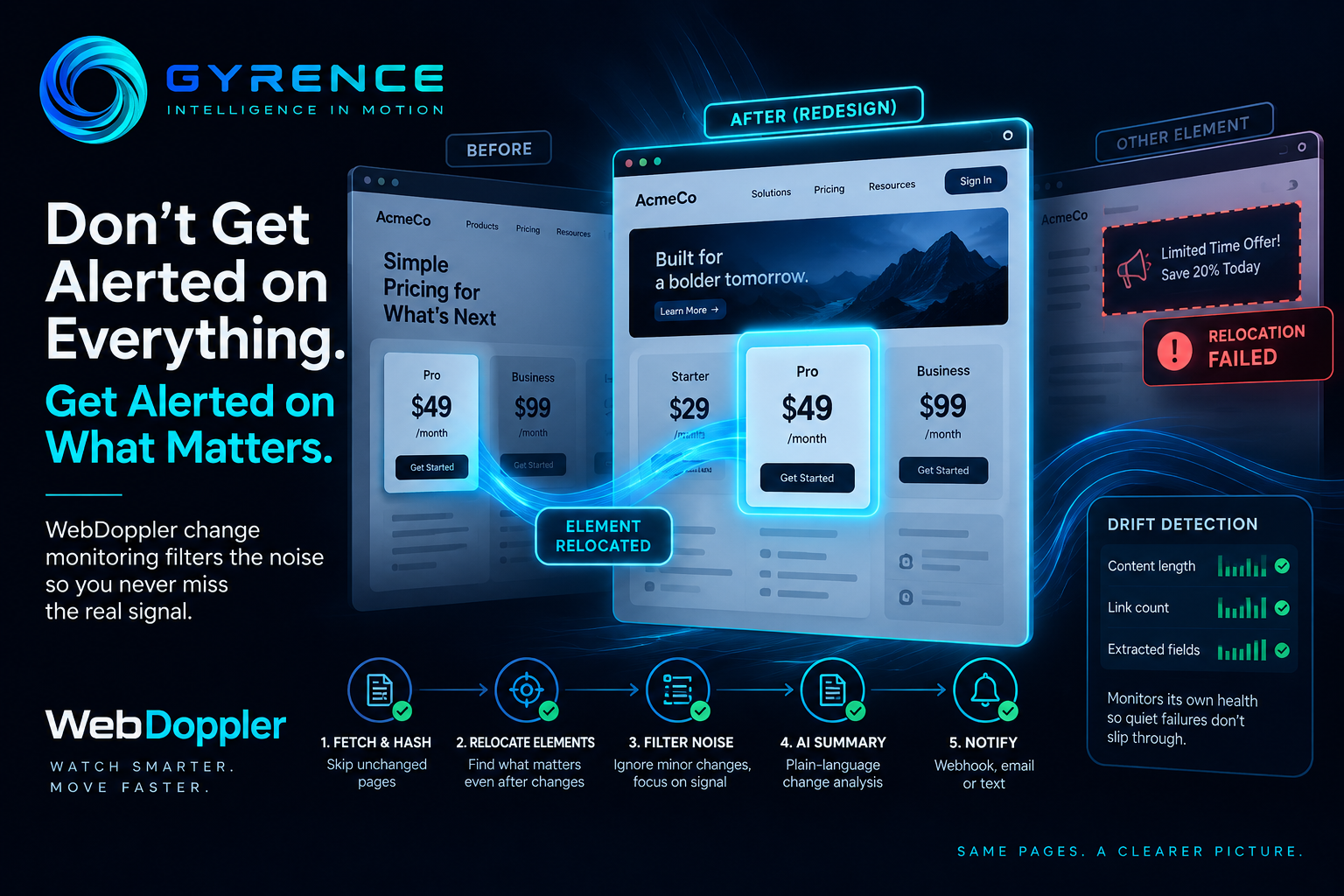
First, WebDoppler fetches the page and computes a content hash. If the hash matches the last known-good version exactly, the run stops immediately and reports "unchanged" — no wasted work, no noise.
If the hash differs, the interesting part starts. Pages get restyled and restructured constantly, so you can't just diff two versions of the underlying code line by line — a redesign would look like total chaos even if the actual content didn't move. Instead, WebDoppler builds a "fingerprint" for each meaningful element on the page (its text, its position, its structural context) and uses a similarity score to relocate that same element even after the surrounding code has shifted around it. This technique is adapted from an open-source library called Scrapling, which uses it to keep automated scrapers pointed at the right element when a site's layout changes. Gyrence adds the inverse capability on top: instead of just relocating an element, it produces a structured diff of what changed at that location — a list of fields with their old value, new value, and a ratio describing how much the content actually shifted.
That diff then passes through a second filter tuned for magnitude: tiny content shifts (an updated "last modified" date, a one-character typo fix) get suppressed by default, while anything above the threshold moves forward. What survives gets handed to an AI extraction step that turns the raw diff into a plain-language summary of what changed, and only then does WebDoppler fire a webhook to your application — signed with an HMAC-SHA256 signature (a cryptographic checksum that lets you verify the payload actually came from Gyrence and wasn't forged or tampered with in transit) so you can trust what you're receiving.
Catching the failure you can't see
There's a second, quieter problem with any long-running monitor: extraction can degrade silently. A site tweaks its code in a way that doesn't trip the diff logic but does cause your extraction to start missing half the content it used to capture. WebDoppler runs a separate drift detector alongside the change pipeline that tracks shape metrics — how much text a page returns, how many links it contains, how many structured fields get extracted — against a rolling history of recent runs. If those numbers suddenly deviate from what's normal for that page, it flags the run even when no "change" was otherwise detected. It's less like a change alert and more like a heartbeat monitor for your own data pipeline.
Why this matters for anything you're building
Every outcome from a WebDoppler run comes back as one of a fixed set of structured states — unchanged, changed, blocked, or a handful of others — rather than a wall of text you have to interpret. That's deliberate: an agent or a downstream workflow can branch on a status code, but it can't reliably branch on "well, kind of changed, maybe check it yourself." And because WebDoppler shares its underlying fetch infrastructure with the rest of Gyrence's retrieval tools, the same reliability work that keeps ordinary scraping requests working when a site pushes back — escalating to a full browser session when a simple request gets blocked, for instance — carries over to monitoring runs too.
The result is a monitor you can point at something that genuinely matters — a regulatory filing page, a pricing page, an investor announcement feed — and trust to bother you only when it's actually time to look.